INVESTIGATIVE · TREATY 6, 7, 8 · OIL & GAS

The Playbook: How Canada's Oil Industry Leaves Billions in Cleanup Costs on Treaty Land

An interactive investigation into the mechanics of regulatory capture, dereliction, and the wells Canada can no longer afford to clean up — on land the Crown promised to share.

WHOSE LAND THIS IS

Treaty 6, Treaty 7, Treaty 8.

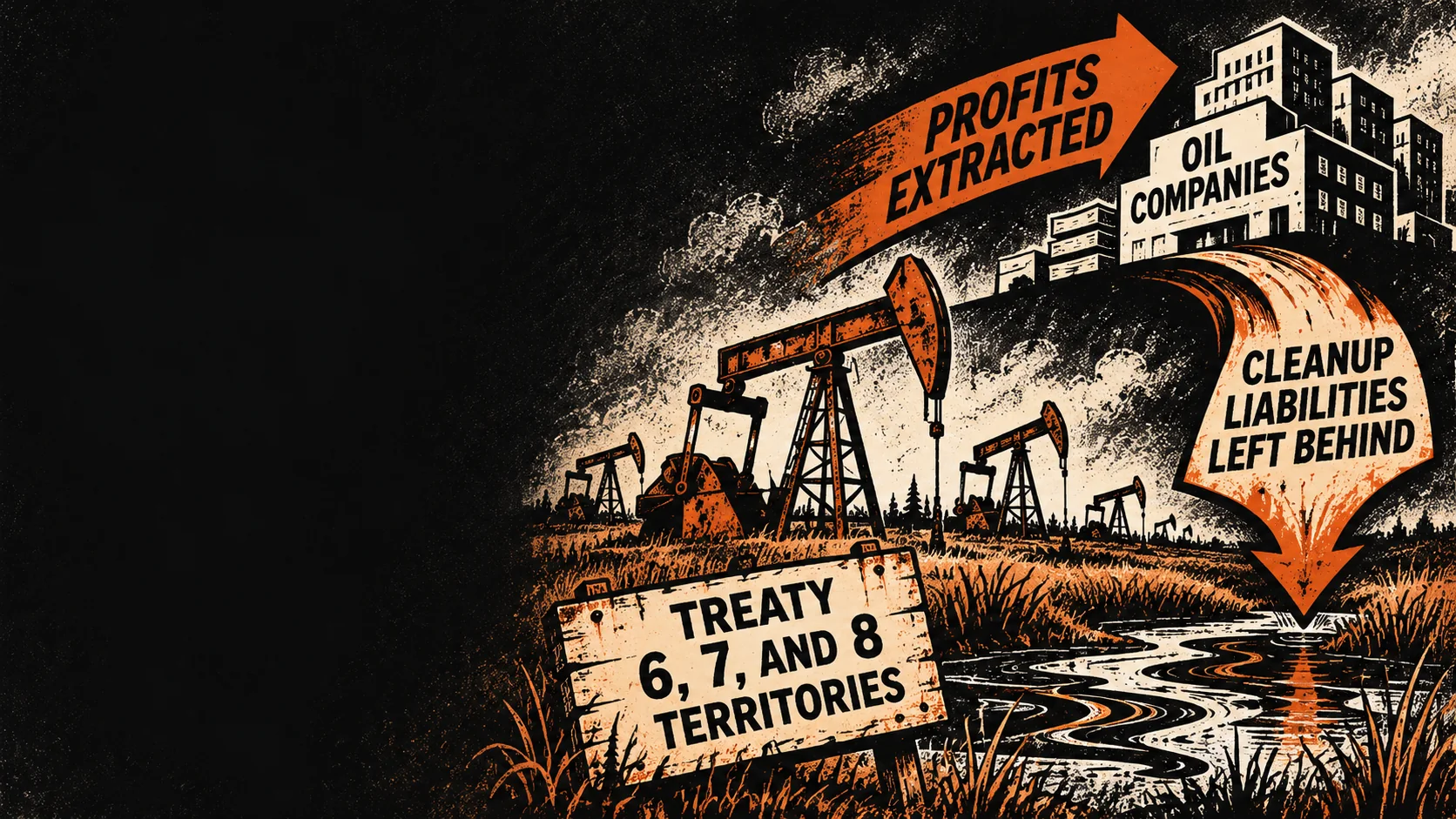
The wells in this investigation are overwhelmingly on Indigenous land. Alberta's orphan well inventory sits on the territories of the Beaver Lake Cree, Cold Lake First Nations, Mikisew Cree, Athabasca Chipewyan, Fort McKay, Tsuut'ina, and dozens of Cree, Dene, and Métis communities whose ancestors signed Treaty 6, Treaty 7, and Treaty 8. Saskatchewan's orphan inventory sits on the same treaties plus Treaty 4 and Treaty 10.

The treaties are not dead letters. They are the legal instrument under which the Crown was permitted to share this land in the first place, subject to explicit obligations about hunting, fishing, and the continued use of the land by its signatory nations. Every orphaned well on treaty territory is, among other things, a treaty question: whether the Crown can authorise its licensees to extract for decades and then abandon the cleanup onto the people whose land was shared on the condition that this would not happen.

When "taxpayers pay for cleanup" gets said in the rest of this piece, remember whose taxpayers, and whose land.

Drawing: a river runs through forest below a map of Treaty 6, 7 and 8, as a woman in profile looks on.

Affected Nations named in this investigation

  • Beaver Lake Cree Nation
    Treaty 6
    88% of traditional territory taken for industrial development; 35,000+ oil and gas sites documented.
  • Cold Lake First Nations
    Treaty 6
    Treaty territory contains thousands of inactive and orphan wells.
  • Mikisew Cree First Nation
    Treaty 8
    Downstream of Alberta oil sands; Treaty 8 cumulative-impacts concerns on the record.
  • Athabasca Chipewyan First Nation
    Treaty 8
    Downstream health impacts; longstanding opposition to expansion without consent.
  • Fort McKay First Nation
    Treaty 8
    Surrounded by oil sands operations; complex mix of legal challenges and operator partnerships.
  • Tsuut'ina Nation
    Treaty 7
    Chief Roy Whitney publicly named operator walk-aways on First Nations land as a core problem.
0
Total oil & gas wells in Alberta and Saskatchewan
$0B+
Estimated cleanup liability (AER private estimate)
0%
Security bonds vs. actual cleanup cost

More than three decades ago, Canadian regulators were warned: a contracting oil industry was creating a ticking environmental liability, concentrating aging wells in the hands of cash-strapped drillers. Little was done. Today, Alberta and Saskatchewan together have more than 700,000 wells — the majority inactive, many leaking brine, methane, and benzene into farmland, muskeg, and waterways that First Nations have relied on since long before the treaties were signed. The industry has already left tens of thousands of these wells as orphans, meaning companies walked away and left the cleanup to the public, to rural municipalities, and — disproportionately — to the Indigenous communities whose territories the wells sit on.

Canada's oil patch is increasingly split between a handful of high-producing wells generating record profits and everything else. Researchers estimate roughly two-thirds of all wells in Alberta and Saskatchewan no longer produce. The question of who pays for cleanup keeps getting deferred. Time and again, oil companies have offloaded their oldest wells using a set of tactics so consistent, so repeatable, that researchers and observers have given it a name: the playbook. Chief Roy Whitney of Tsuut'ina Nation put the consequence plainly — "too many oil and gas companies have simply walked away from their obligation to remediate their well sites on First Nation lands."

VOICES FROM THE TERRITORY

What the people whose land this is have to say.

  • “Too many oil and gas companies have simply walked away from their obligation to remediate their well sites on First Nation lands.”
    Chief Roy Whitney — Tsuut'ina Nation (Treaty 7)

    On the 2020 federal Site Rehabilitation Program and its failure to reach wells on First Nations land.

    Source: CBC News — First Nations and the Site Rehabilitation Program
  • “More than 88 percent of Beaver Lake Cree Nation traditional territory has been taken up for industrial development — over 35,000 oil and gas sites, 21,700 kilometres of seismic lines, and 4,028 kilometres of pipeline on land the Crown promised to share.”
    Beaver Lake Cree Nation — Treaty 6 — constitutional challenge on cumulative impacts

    BLCN has pursued a constitutional challenge against Alberta and Canada, arguing the cumulative footprint of resource development on their territory is itself a violation of Treaty 6. In 2022, the Supreme Court of Canada granted them advance costs — a recognition that the case is of public importance.

    Source: Beaver Lake Cree Nation — Defend the Treaties campaign
  • “Alberta returned $137 million in federal orphan well cleanup funds unspent, while at least 900 wells on First Nations land still qualified for cleanup.”
    The public record — Government of Canada / Government of Alberta / CBC News

    Of the $1.72 billion federal Site Rehabilitation Program, $85 million was allocated for First Nations cleanup and $15 million for Métis communities. First Nations leaders publicly asked to be allowed to direct the unspent Alberta portion toward wells on their own land. The money was returned to Ottawa instead.

    Source: CBC News — Alberta gives back $137M to Ottawa in unspent funds to clean up inactive wells

The Playbook

01

Collect subsidies. Then drill.

Flow-through shares, royalty holidays, federal incentives. Lock in profits while the well is productive. The public helped pay to put the hole in the ground; the public will also pay to fill it back in.

KNOWLEDGE CHECK

Roughly what share of oil & gas capital costs in Canada has historically been offset by public subsidies, incentives, and royalty holidays combined?

Drawing: a hand labelled oil companies takes a money bag marked public subsidies, taxpayer dollars, from in front of a legislature.
02

Build a labyrinth of shell companies.

Numbered Alberta LPs and corporations. Each layer is a firewall between personal wealth and environmental liability. When the regulator finally comes asking who is responsible, every arrow points to a company with no bank account and no assets.

KNOWLEDGE CHECK

What type of corporation is most commonly used in Alberta to hold individual well licences as a firewall against liability?

Drawing: profits flow down a stack of buildings from parent company to holding company to subsidiary to a shell company left holding the liabilities.
03

Sell your oldest wells down the chain.

Off to "scavenger companies" operating on thin margins. Cleanup obligations transfer with the deed. Environmental stewardship falls away. The original operator is now entirely out of the picture — and no longer legally on the hook.

KNOWLEDGE CHECK

When an oil company sells a declining well to a "scavenger" operator, who is legally responsible for cleanup?

Drawing: a hand labelled Big Oil passes papers marked well assets, aging, to a hand labelled small operator.
04

Let them go inactive. Indefinitely.

Alberta rules allow wells to sit idle for years with no plugging requirement. Research shows most never produce again. Inactive wells emit 545,000 tonnes CO₂-equivalent per year across Alberta and Saskatchewan — a silent, ongoing climate cost that no one is currently paying.

KNOWLEDGE CHECK

Inactive wells in Alberta and Saskatchewan emit roughly how many tonnes of CO₂-equivalent per year?

Drawing: a rusted pump jack stands in tall grass behind a sign reading inactive, years, no cleanup.
05

Stop paying your bills.

Municipal taxes: $173M unpaid in Alberta in 2019 alone. Landowner rent: taxpayers paid out $30M in 2024; less than $167K was recovered from companies. Rural municipalities absorb the loss; the province writes it off.

KNOWLEDGE CHECK

How much did Alberta taxpayers pay out to landowners in 2024 to cover unpaid rent from oil companies (in millions)?

Drawing: property tax and land rent bills stamped unpaid pile up in a field.
06

Threaten regulators with your own bankruptcy.

If they push too hard, warn that enforcement will tip you into insolvency, making things worse. Regulators routinely back down. The calculation is explicit: the AER cannot enforce what the industry cannot afford.

KNOWLEDGE CHECK

What is the regulator's most common response when a struggling operator threatens that enforcement will push it into bankruptcy?

Drawing: in front of a building labelled regulator, a checklist has enforce cleanup, require adequate bonds and hold companies accountable all crossed out.
07

Declare bankruptcy. Lose the bond. Keep the profits.

File under Canada's Bankruptcy and Insolvency Act. Forfeit the security deposit — which covers under 2% of true cleanup costs. The profits extracted in earlier steps stay with directors, shareholders, and the numbered LPs upstream. Walk away clean.

KNOWLEDGE CHECK

What percentage of true cleanup costs are covered by the security bonds oil companies post before drilling?

Drawing: a bankruptcy notice beside a bond slip reading under 2%, over a strip reading cleanup costs 38 billion dollars, AER 2025.
08

Let the Orphan Well Association inherit your mess.

The OWA, funded by a levy on the remaining industry, takes over. Cleanup timeline now projected to 2037–2040 and growing. The public sees the word "industry-funded" and assumes the problem is being handled. It is not.

KNOWLEDGE CHECK

When is the Orphan Well Association currently projected to complete cleanup of its existing inventory?

Drawing: pump jacks behind a sign reading orphan well, no responsible owner, cleanup cost unsecured.

THE DATA

The numbers behind each step.

01

The well inventory

Active wells are at their lowest share in recorded Alberta history. More than half of the provincial inventory is inactive — a category that, as step 4 explains, tends to become permanent.

02

Orphan well growth

Alberta orphan wells: 700 in 2010 → 8,600+ by 2020 → a post-Sequoia record high now.

03

The bond gap

Industry has posted about $237M in security. The AER's own books value the cleanup at $38.0B at the end of 2025, and independent and internal estimates put it closer to $100B. In 2025, $1.71B in inactive and marginal liability changed hands through licence transfers; the AER collected $33.2M in security, under 2%. The gap between what's secured and what's owed is the core of step 7.

04

Federal relief misdirected

Of the $1.7B COVID-era federal cleanup program, roughly half went to financially viable companies including CNQ and Imperial Oil.

A testable next step

Can a small number of old wells help us see underground?

Fiber-optic sensing can turn a wellbore into a continuous acoustic, temperature, or strain sensor. The technology is proven; its fit for Canada's orphan-well inventory is not. We separate what is known, what is missing, and what a responsible pilot would have to prove.

Examine the monitoring proposal

CASE STUDY

Sequoia Resources: Sold for $1, Left for the Public

  1. 2016
    Perpetual Energy moves its non-producing wells into a subsidiary and sells it for $1. It becomes Sequoia Resources.
  2. 2018
    Sequoia goes bankrupt in March. PwC, as trustee, sues Perpetual for $217.6 million.
  3. 2024
    Perpetual settles for $30 million, without admitting liability.
  4. 2025
    The AER orders the Orphan Well Association to take over about 2,500 sites. Almost 1,800 wells still need plugging.

In October 2016, Perpetual Energy moved a block of aging, non-producing wells into a subsidiary and sold that subsidiary for $1 to a company owned by Kailas Capital. Renamed Sequoia Resources, it held licences for about 2,300 wells, almost 200 facilities and nearly 700 pipeline segments. Seventeen months later, in March 2018, it was bankrupt. The trustee, PwC, sued Perpetual for $217.6 million, arguing the transfer was built to shed cleanup costs. Perpetual settled in 2024 for $30 million, without admitting liability. The cleanup is estimated at about $200 million.

The bankruptcy took nearly seven years to wind through the courts. In January 2025 the AER ordered the Orphan Well Association, the industry-funded body that inherits wells with no responsible owner, to take over about 2,500 Sequoia sites, including almost 1,800 wells that still need plugging. The OWA's well inventory more than doubled in one day. "The Sequoia impact is huge. I still think it might be a little bigger than I expected," said Drew Yewchuk, a former staff lawyer with the University of Calgary's Public Interest Law Clinic who closely follows the issue. Fourteen months later, Long Run Exploration left a bill more than twice as large.

“The Sequoia impact is huge. I still think it might be a little bigger than I expected.”
— Drew Yewchuk, U of Calgary Public Interest Law Clinic

AI-read from source — not the speaker's actual voice.

CASE STUDY

Long Run Exploration: A Bigger Bill, Routed Offshore

  1. 2016
    Calgary Sinoenergy Investment Corp. buys Long Run in a deal reported at C$780 million including debt. Ownership runs through Sinoenergy Oil Investment Ltd. in the British Virgin Islands to Qingdao Sinoenergy in China.
  2. 2022
    Long Run misses its cleanup targets. The AER issues a notice of security deposit owing. Long Run appeals, then withdraws the appeal in May 2024.
  3. Jul 2024
    Creditor protection, on the application of China Construction Bank, owed about $350 million. Long Run also owes about $544 million to its own parent.
  4. Nov 2024
    A court approves a $22 million sale to a Chinese buyer. It never closes: the buyer cannot move the money out of China.
  5. Mar 2025
    Receivership, on the Orphan Well Association's application. PwC is appointed receiver and sells what it can.
  6. Apr 2026
    The AER hands the rest to the Orphan Well Association: 4,031 wells, 383 facilities and 2,121 pipeline segments.

In February 2025, the AER put Long Run Exploration's cleanup liability at $476.8 million. That is more than double Sequoia's roughly $200 million, and above the $329 million left by Trident Exploration in 2019, which the AER then called the biggest insolvency it had handled. On April 9, 2026, the AER designated Long Run's remaining inventory to the Orphan Well Association: 4,031 wells, 383 facilities and 2,121 pipeline segments, mostly gas.

The court filings show where the money and the liability went. When Long Run filed for creditor protection, its books showed $1.36 billion in liabilities against $782 million in assets, and about $544 million of that debt was owed to its own parent. In 2022 the AER demanded a security deposit after Long Run missed its closure targets. Whether any deposit was ever paid is not on the public record. Under the Supreme Court's 2019 Redwater decision, cleanup ranks ahead of creditors, so the receiver asked to send $10 million of its roughly $26 million in cash to the AER. The OWA expects the transfer to add about $500 million to its costs and 2,980 wells to its plugging list.

$780 million in 2016. A $22 million sale that couldn't close in 2024. A $476.8 million cleanup bill left with the Orphan Well Association in 2026.

THE LEDGER · AER REPORT, NOVEMBER 2026

$38 billion owed. Who holds it, who moved it, who didn't pay.

On November 9, 2026, the Alberta Energy Regulator published its liability report for 2025. These are its own numbers, read line by line.

$38.0B

The AER's own estimate of what it costs to close and reclaim Alberta's oil and gas sites, end of 2025

+$1.0B

Growth in one year, from $37 billion, in a year when more than $1 billion was spent on cleanup

35+ yrs

Years of work in the current bill alone, at 2025's record cleanup pace of about $1.07 billion

Industry reported $912 million in eligible cleanup spending in 2025, and the Orphan Well Association spent $154 million. The mandatory industry quota was $750 million. The bill still grew by $1 billion. The AER now updates its cost figures with closure-spend data the companies submit themselves: the companies that owe the money help set the price.

Where the liability moved in 2025

When wells are sold, the cleanup obligation goes with them. The AER can demand security from the buyer before it approves the transfer. In 2025, about 30,600 wells changed hands, carrying $1.71 billion in inactive and marginal-well liability. The AER collected $33.2 million in security. 98% of the liability moved with nothing posted against it.

Licence transfers in 2025 by the buyer's assessed capability: wells, inactive and marginal liability, security collected
Transferred toInactive + marginal liabilitySecurity collectedSecured
Companies of "equal risk"$1.53B$20.5M1.3%
Less capable companies$8.27M$2.17M26.2%
More capable companies$50.4M$3.13M6.2%
New companies$113.8M$7.42M6.5%
All 2025 transfers$1.71B$33.2M1.9%

Source: AER, Table 1, transfer analysis by licensee capability. Liability is inactive liability plus liability for marginal wells. The AER also counts $2.59 billion in total liability transferred. Most of the 2025 volume came from several large acquisitions between companies the AER rated as equally capable.

Who didn't pay

96 active companies neither did their required 2025 cleanup work nor posted security in its place. Together they owe $22.8 million, 3% of the industry quota, and by October 2026 the AER had collected $2.52 million of it. The Narwhal compared this list with the orphan-levy records and found 35 companies that also failed to pay the levy that funds orphan cleanup. The dollar gap is small. The quota is set low enough that most companies clear it, and the ones that don't still hold their licences.

These companies missed their quota three years running, 2023, 2024 and 2025, and still hold active licences. The AER names them, with the security each still owes:

  1. Kasten Energy Inc.$1,742,986
  2. Renergy Petroleum (Canada) Co., Ltd.$1,121,422
  3. Sunshine Oilsands Ltd.$579,651
  4. Mutiny Oil & Gas Ltd.$188,641
  5. Mooncor Energy Inc.$94,944
  6. Bluestone Resources Inc.$47,103
  7. Bay Trail Resources Ltd.$8,441
  8. Ridgeway Petroleum Corp.$7,990
  9. Petebrook Investments Ltd.$7,755
  10. Mass Resources Ltd.$7,292
  11. Glen Isle Exploration Ltd.$6,630
  12. Topeka Energy Inc.$6,405
  13. True North Oil & Gas Limited$6,405
  14. Frank O'Sullivan Petroleum Western Ltd.$5,315
  15. 1099477 Alberta Ltd.$3,878
  16. Pantera Silver Corp.$3,878

Source: AER, Table 5. The AER's text says 17 licensees; its table names these 16.

Who carries the unsecured part

Unsecured is not the same as abandoned. 82% of the $38 billion sits with companies the AER rates as low financial distress. They still owe it, and the law still requires them to pay. The risk sits further down: more than $1.7 billion is held by companies in high financial distress, and $5 billion by companies in medium distress. That figure leaves out licences still held by companies already insolvent.

When one of those companies fails, there is almost no security to seize. Its wells go to the Orphan Well Association, funded by an industry levy of $144.45 million in 2025. When the levy falls short, the cost lands on landowners, rural municipalities, Treaty Nations and the public. Alberta and Ottawa have already lent the OWA public money to keep up.

Sources
THE MONEY LOOP

How to Buy the Regulator (Legally, With Your Own Subsidy Money)

subsidies &royalty holidaysunlimiteddonationsfriendlyregulationsnon-enforcementcleanup costsback to...$TAXPAYERSOIL COMPANIESSASKATCHEWAN PARTYAER / SK ENVIRONMENTORPHANED WELLS

Saskatchewan has no donation limits — corporations can give unlimited amounts.

Elections Saskatchewan

Oil & gas companies can donate from outside the province — Alberta companies freely fund SK politics.

Progress Alberta / CBC

Political donations get a 75% tax credit on the first $400, funded by taxpayers.

SK Political Contributions Tax Credit Act

The SK Party has taken in 46% of all donations from corporations since 2006.

Press Progress

Since 2006: $3M+ from out-of-province corporate donors, $2M+ from Alberta alone.

Progress Alberta

Cenovus donated $68,108 (2010–2015); Encana $50,557; Crescent Point $126,924.

Elections Saskatchewan records

Saskatchewan is the only province in Canada with no cap on corporate political donations.

U of S Graduate School of Public Policy

TAX CREDIT CALCULATOR

Saskatchewan gives a tax credit on political donations. Enter an amount to see how much flows back from the public treasury.

$

SK Political Contributions Tax Credit Act: 75% on first $400, 50% on $400–750, 33% on $750–1,275. Max $650/yr.

“Saskatchewan is one of the worst — if not the worst — in Canada for its political finance system.”
— Duff Conacher, founder, Democracy Watch

AI-read from source — not the speaker's actual voice.

The playbook doesn't work without a sympathetic regulator. Sympathetic regulators don't persist without sympathetic governments. And sympathetic governments don't persist without money. In Saskatchewan, unlike every other major Canadian province, there is no limit on how much an oil company can donate to the party that appoints its regulators — and a portion of every donation flows back from the public treasury as a tax credit. The companies are, in a very literal sense, buying access with money that was partly the public's to begin with. The land underneath it was never theirs to begin with at all.

Related Reporting

Indigenous InsiderSubstackApril 24, 2026

By Brandi Morin

Hillman Prize-winning journalist Brandi Morin sent the Province of Alberta thirteen on-the-record questions about a cancer crisis in Fort Chipewyan — children diagnosed, data withheld, a Chief Medical Officer who has never set foot in the community. Alberta has not replied.

Read the full investigation

Same Playbook, Different Victims

Five things both stories tell us. Share one.

The orphan-well crisis and the Fort Chipewyan cancer crisis aren't two separate scandals. They're the same arrangement, viewed from two angles. Pick a tile, post it, make Alberta's silence harder to ignore.

  • Denial

    01 / 05

    Same playbook, different victims. In Alberta, companies declare wells "closed" while they leak methane. The province declares Fort Chipewyan's cancer rates "within normal range" while children are diagnosed. Both built on incomplete data.

  • Downstream Cost

    02 / 05

    Cleanup costs flow to taxpayers. Toxic wastewater flows to Fort Chipewyan. The pattern is the same: profits stay private, harm gets socialized. Alberta cashes the royalty cheques. Everyone else gets the bill.

  • Treaty Land

    03 / 05

    Most of Alberta's 466,000 wells sit on Treaty land. Most of its tailings ponds drain through Treaty waters. Indigenous communities aren't a footnote in the oil sands story — they're the ones paying first.

  • Regulators Don't Visit

    04 / 05

    The AER backs down when companies threaten bankruptcy. Alberta's Chief Medical Officer issued a public health assessment of Fort Chipewyan without ever setting foot there. Two crises. One regulatory style: don't look.

  • Silence as Strategy

    05 / 05

    Imperial Oil's Kearl Mine spilled 5.3M litres of toxic wastewater. Fort Chipewyan wasn't told for 9 months. Journalist Brandi Morin sent Alberta 13 questions about the cancer crisis. Radio silence. When governments go quiet, that's the answer.

WHAT NEEDS TO CHANGE

What Needs to Change

Alberta's proposed "Mature Asset Strategy" (MAS) is what the province calls its plan for addressing the liability. Critics — including University of Calgary law professors and watchdog groups — call it a rigged plan: it delays cleanup, preserves industry discretion, and embeds the same non-enforcement patterns the playbook relies on.

What would actually work is not mysterious. Mandatory cleanup deadlines tied to well age. Real bond requirements proportional to estimated liability, not the rounding-error figures currently posted. Polluter-pays enforcement with personal liability for directors of shell operators. And a ban on corporate political donations to the governments whose regulators oversee the industry — at minimum in Saskatchewan, the only province where no cap currently exists.

None of this is radical. All of it is already law in one jurisdiction or another. The barrier is not technical. It is political, and the playbook explains why.

SPREAD THE WORD

10 facts. 10 posts. One playbook the industry doesn't want shared.

Each card is a ready-to-post fact. Pick one, hit share, and track your progress. The more people who see this, the harder it is to ignore.

0 of 10 shared

“Canada has 708,000 oil & gas wells across Alberta and Saskatchewan. Industry bonds cover under 2% of cleanup costs. When a company fails, the rest falls to the orphan system, landowners and the public.”

Links to: https://oildebt.ca

WHAT YOU CAN DO

The playbook works because nothing happens. Make something happen.

Contact your MP and MLA

Enter your postal code. We look up your federal and provincial representatives, then build an email you can edit and send from your own mail client.

Sign the open letter

Get updates